
If you grew up in Spain or know your arts, you’ll likely know Federico García Lorca. If not, be seated. The iconic, Granada-born 20th century poet and playwright — a friend of Salvador Dalí, and a gay man — lived during the Spanish Civil War, a time when political violence was rife and queerness was persecuted.
Lorca began writing the play La Bola Negra in 1936, the first year of the war between Republicans and Franco’s fascist Nationalists — and the same year he was murdered by the latter. And it’s this piece of unfinished theatre that lies at the heart of Javier Calvo and Javier Ambrossi’s extraordinary 2026 film, a magnificent epic that draws threads between Lorca’s work and the Spanish men connected to it.
‘Behemoth!’ review: Pedro Pascal’s cellist drama is (mostly) music to our ears
It’s a devastating film that will leave you heartbroken, for sure, but it’s a vital, transcendent experience. With exemplary performances, transfixing cinematography, and a non-linear narrative fuelled by a family mystery, La Bola Negra brings lost pages of queer, literary, and political history to life. And we won’t be forgetting that musical appearance from Penélope Cruz anytime soon, either.
La Bola Negra humanises history, drawing threads from the Spanish Civil War to the present.
A film of three contexts, La Bola Negra connects gay men across time within Spain: Carlos in 1932, Sebastián in 1937, and Alberto in 2017. Here, Calvo and Ambrossi, with fellow screenwriter Alberto Conejero, run parallel to Mascha Schilinski’s Sound of Falling, with both films weaving a complex tapestry of characters across time. But here, thanks to editor Alberto Gutiérrez, these men’s stories are directly connected, and it’s the puzzle of the film to bring them together.
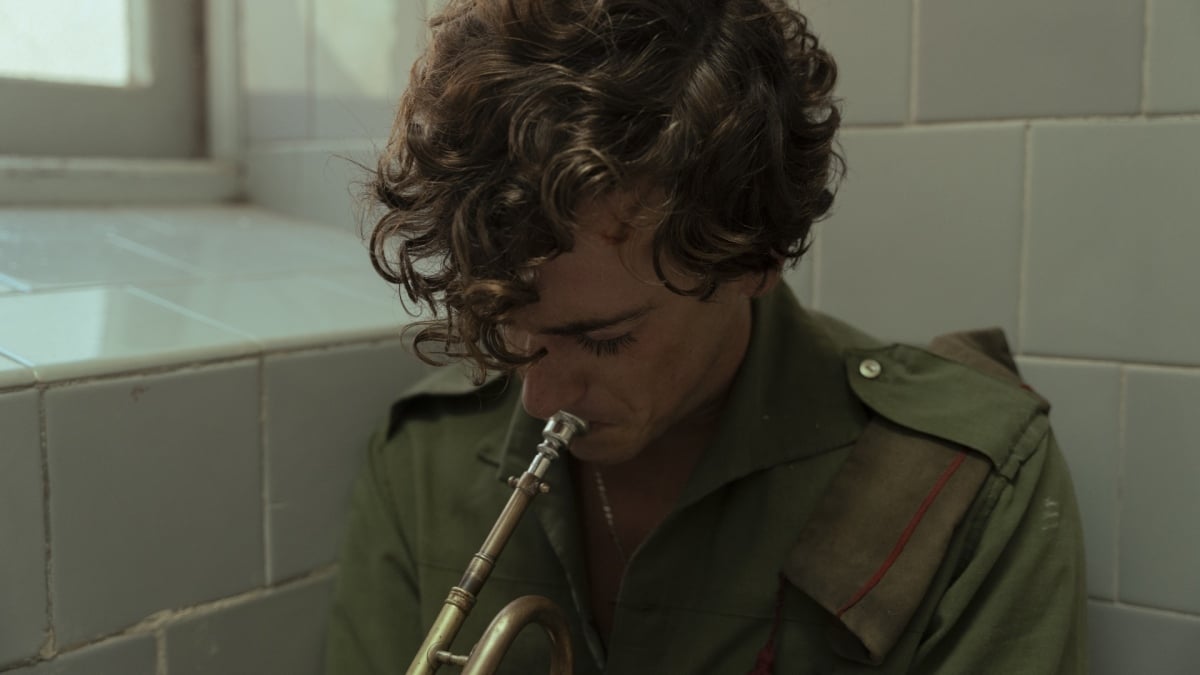
We first meet Sebastián (an exceptional debut from Álvaro Lafuente Calvo, aka musician Guitarricadelafuente), who is forced into the Nationalist army. We meet this gentle trumpet player in a shocking opening scene in which his northern Spanish village in Cantabria is destroyed by Italian forces. It’s a sequence visually reminiscent of Pablo Picasso’s 1937 masterpiece Guernica, the nearby site of similarly devastating Civil War violence (and painted in the same year as Sebastián’s storyline). Horses run in terror, homes burn, children mourn slain mothers, and soldiers surround the village, as Raül Refree’s haunting choral score sounds.
Forced into the ranks of fascists, Sebastián is assigned to a Nationalist army hospital near key battleground Santander, where truckloads of wounded bodies arrive daily, very few alive. He’s ordered to guard injured Republican lieutenant colonel Rafael Rodríguez Rapún (a wonderful Miguel Bernardeau), a prisoner of war peeled from the pile. No hate in his heart, Sebastián feels drawn to this beautiful stranger, supposedly the enemy. As for Rafael, he holds the key to the whole triptych, the heart of La Bola Negra itself.
Second, we meet the young Carlos (talented newcomer Milo Quifes) in pre-war Granada, rejected from an aristocratic casino because of his homosexuality. Third, with a rattling cut to modern smartphone technology, we meet Alberto (an excellent Carlos González) in the near-present, a historian and playwright whose casual Grindr dalliances are interrupted by an unexpected family inheritance. Such a mystery sends him on a quest into the past — and into uneasy conversations with his chaotic mother (a flawless Lola Dueñas).
Mashable Top Stories
How these three storylines connect is the true magic of La Bola Negra, with each tale shedding light on the other, and building a powerful portrait of queer identity across decades.
La Bola Negra weaves queer desire through decades.
Like Glenn Close’s historian character in the film (she’s in it!), La Bola Negra is more concerned with the people between the historical events, especially those of the LGBTQ community, existing surrounded by violent heteronormativity and political chaos. Each storyline simmers in the Spanish heat, with all three mainly set in the height of summer in Granada, Santander, and Madrid.
A profound, steamy connection in the aftermath of violence, the forbidden love story between Sebastián and Rafael simmers with longing, melancholy, and inevitability, with director of photography Gris Jordana exquisitely crafting a glimmer of desire in a hopeless place. In the film’s sparkling musical highlight, a dazzling Penélope Cruz plays Nené Romero, a cupletista who performs for the rowdy Nationalist troops and opens Sebastián’s perspective to the queer experience. (This performance feels deeply linked to Marlene Dietrich’s performance in Witness for the Prosecution as the military crowd grows more and more aggressive).
In Granada, the socially rejected Carlos finds solace with fellow outcasts in sweaty tavernas with his friends, the openly queer Lorenzo (Mario Silva) and painfully tempting Enrique (Hugo Welzel). And in the 2010s, Alberto’s queerness is inextricable from his everyday existence, living a full life in Madrid with his beloved Juan Pablo (a wonderful appearance from Problemista‘s Julio Torres), a historian hesitant to investigate his own story.
And while you’re figuring out the connection between all three storylines, and surviving the tragedies within them, the film thrives from some of the most jaw-dropping production design you’ll see onscreen.
La Bola Negra boasts exquisite historical (and surreal) production design.
Giving you a complicated glimpse into Spain during the Civil War, art director Roger Bellés and costume designer Ana López Cobos have crafted something truly staggering — particularly within the two storylines set in the 1930s. The bloody halls of wartime in Sebastián’s narrative are set against cocktail-abundant Granadan casino parlors in Carlos’ story, the spilt blood and festering wounds of the army hospital contrasting with pure pre-war decadence. The film also plays with surrealism through some stunning sequences, particularly in Carlos’ storyline.
And beneath all of this, Lorca’s poetry and prose burns, the inspiration for such an ambitious triptych. In La Bola Negra, Calvo and Ambrossi not only pay tribute to the Spanish icon, but examine common threads through queer history, ask important questions of inheritance and secrets, and craft a love story so real and devastating you’ll be unlikely to forget it. It’s probably best expressed by Lorca himself, who makes an appearance in the film courtesy of the magnetic Alberto Cortés. “This country has too many love stories buried in the fields,” he says of Spain, but really, you could be anywhere.
La Bola Negra was reviewed out of BFI London Film Festival. It will open in NYC and L.A. on Oct. 16.
Recommended deals for you
HBO Max
—
top pick for premium content
Disney+
—
best for families
Hulu
—
popular choice for originals
Peacock
—
low-cost choice for live sport
Credit: Source link
Support authors and subscribe to content
This is premium stuff. Subscribe to read the entire article.