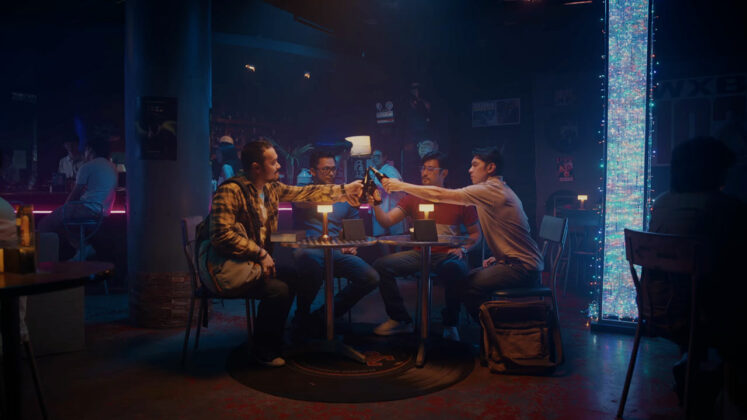


Directed and co-written by Good Luck to You, Leo Grande’s Sophie Hyde, Jimpa is a tale of wish fulfillment on multiple levels — often to its detriment. The first level is its plot, which follows an Australian filmmaker, Hannah (Olivia Colman), taking her nonbinary teenager Frances (Aud Mason-Hyde) to visit her idiosyncratic gay father, Jim (John Lithgow), in Amsterdam, as she begins work on a movie that idealizes her family’s past.
The second level is the film’s own making. Hannah is a stand-in for Hyde, whose own child, Mason-Hyde, makes their onscreen debut in what amounts to a semi-autobiographical retelling of Hyde’s family history, with some poetic license to depict conversations the family could never have before Hyde’s real father passed. These two meta-textual layers imbue Jimpa with intrigue. However, their interplay is informed by a third level, which ultimately kneecaps the movie both visually and thematically. Its desire to present a kind of utopian queer acceptance, while commendable as a real-world end goal, yields flattened characters who speak in grating proclamations, and whose pasts are rendered mere flashes, which the movie fails to emotionally anchor.
Jimpa turns queerness — as identity, history, and lived experience — into texture, but texture alone. Of course, it’s hard to dismiss the film outright, because it’s incredibly well-meaning, and because it draws on a painful real-world story. But the way it expresses its intent, and its message about queer acceptance, ends up grasping at authenticity. The film never finds its truth, resulting in a painfully languid work that merely gestures toward real drama.
Support authors and subscribe to content
This is premium stuff. Subscribe to read the entire article.